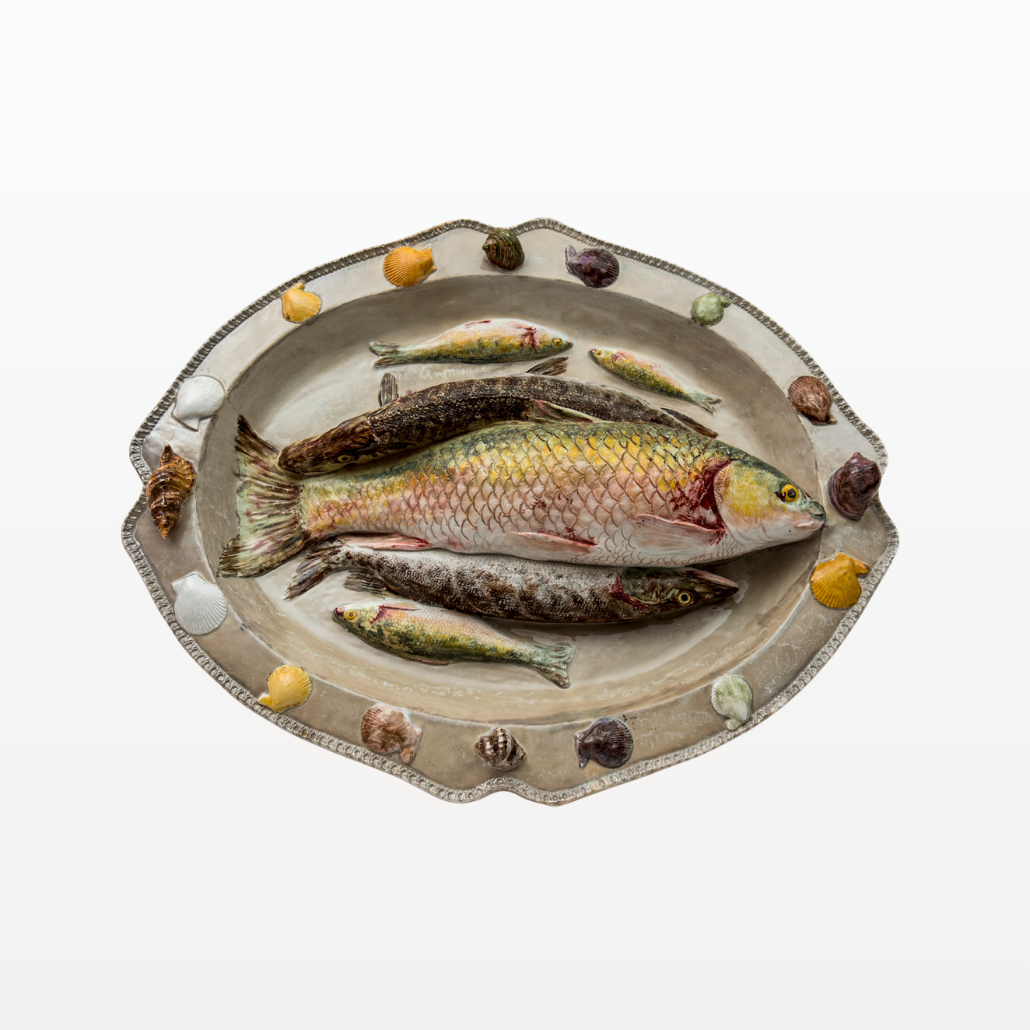
Palissy-style fish dish, c. 1940, France
This fish dish is the work of the Suiveurs de Palissy, artists who, building on the style developed by Bernard Palissy in the 16th century, carry on the tradition of relief compositions inspired by the natural world. As with Palissy, nature is the main subject here, with particular attention paid to realism, modelling and a wealth of detail.
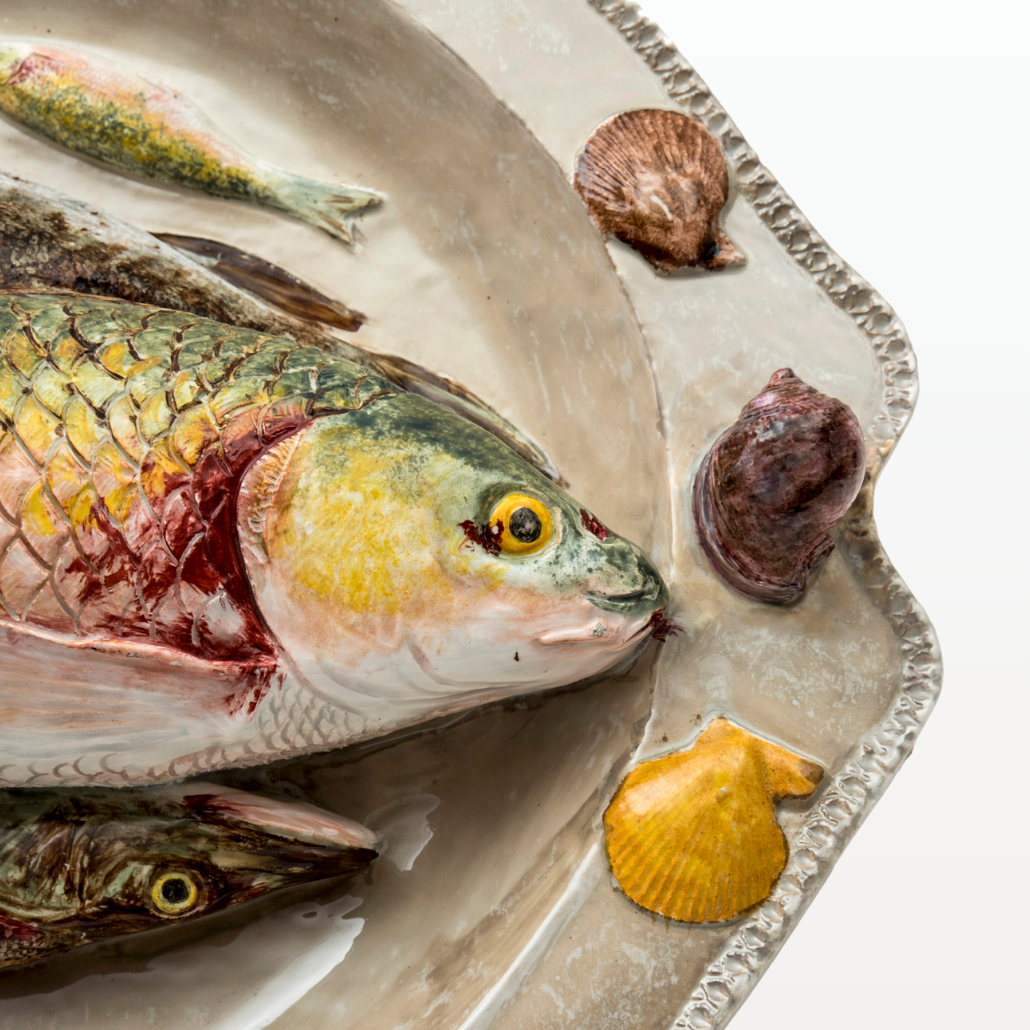
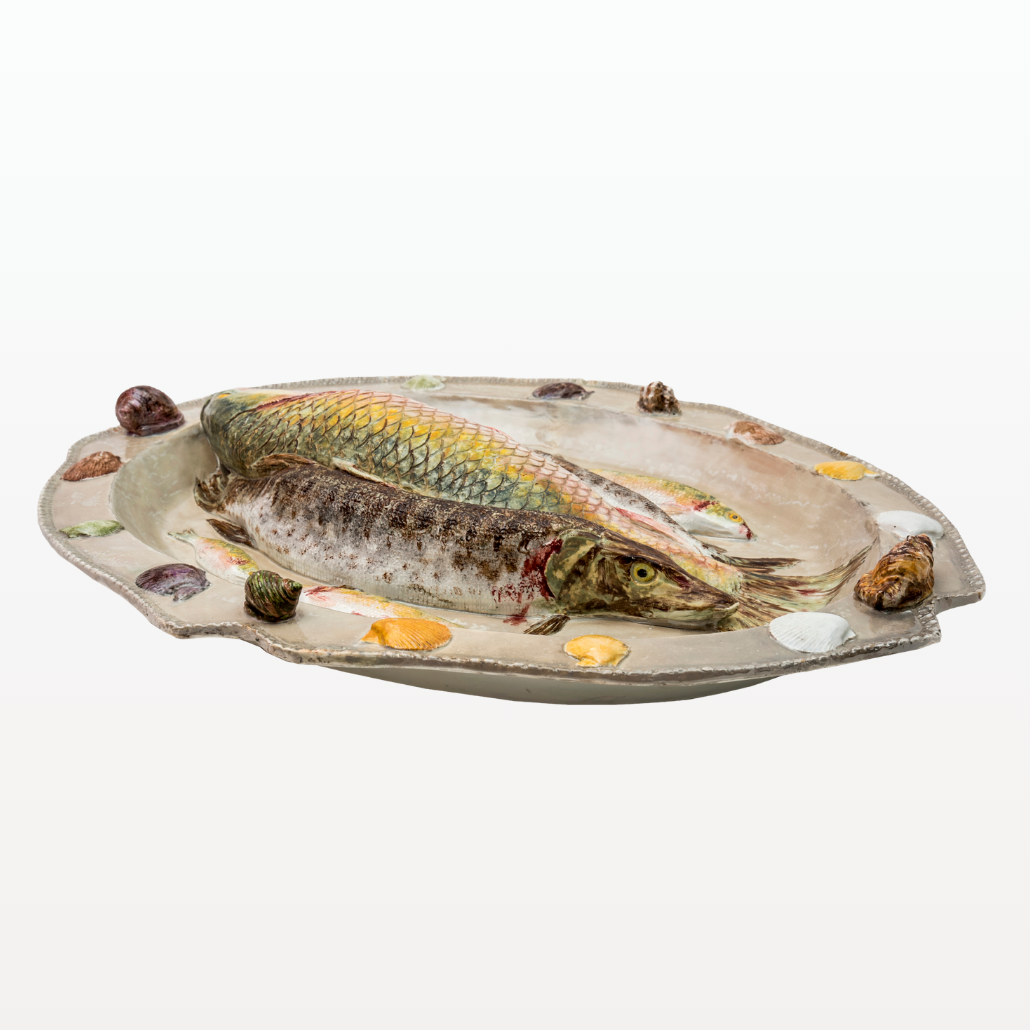
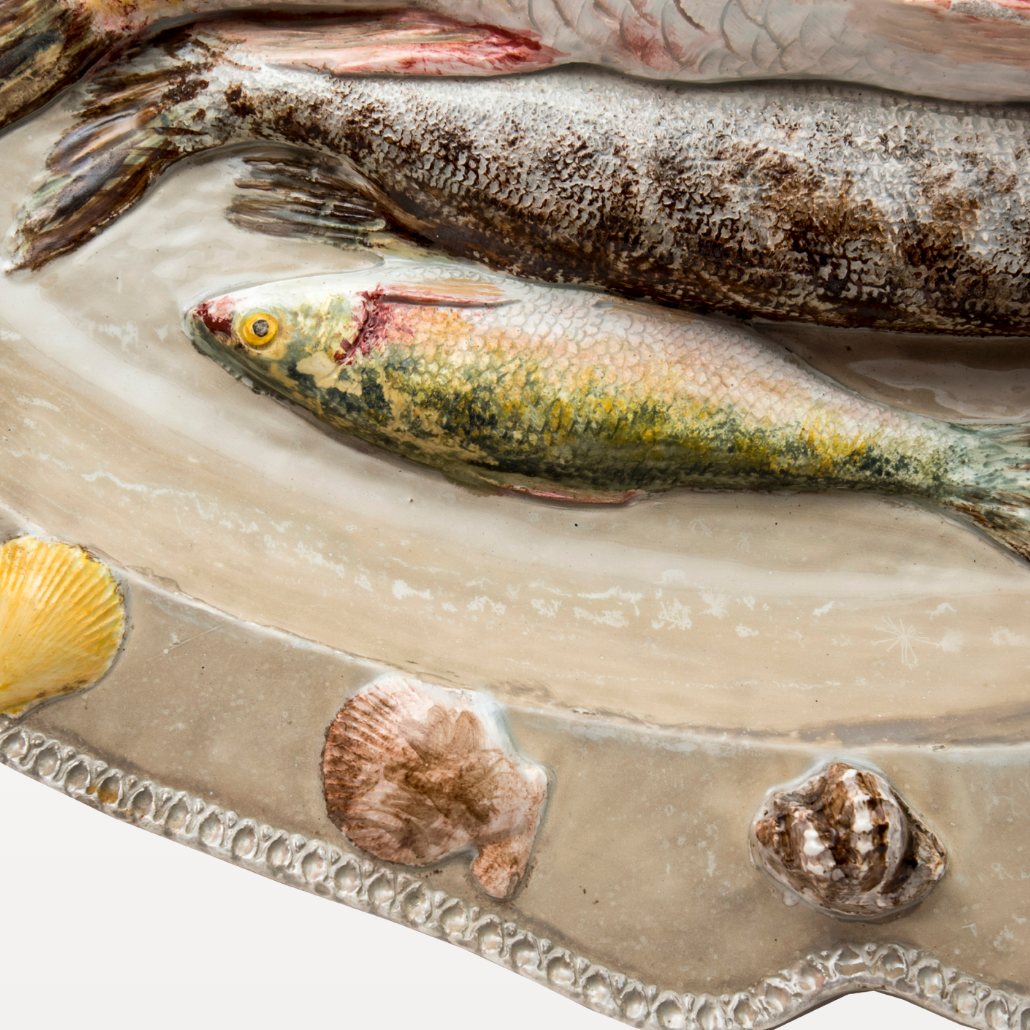
The seven fish depicted in the centre of the dish demonstrate this desire to reproduce living creatures as faithfully as possible. Their bodies are covered in scales, their fins are carefully modelled, and their vivid colours evoke fish freshly caught from the water. The one in the centre, particularly imposing, seems almost too large for the dish: its tail follows the curve separating the base from the rim, lending the composition a sense of movement and overflow. The realism is taken to the point of depicting traces of blood and wounds, a direct evocation of fishing and the killing of animals. This detail, both spectacular and naturalistic, recalls the Palissien style’s penchant for capturing nature in all its materiality.
The fish are not alone. The rim of the dish is brought to life by a multitude of small marine creatures, notably shells of various shapes, sizes and colours. Arranged in relief, they form a teeming border that contrasts with the dish’s beige background. This accumulation of natural elements creates a rich yet balanced composition: the eye moves between the fish, the shells and the different levels of relief.
This pursuit of realism is also achieved through the treatment of the material. The piece follows the technical tradition of Palissy, notably through the use of slip, a ceramic paste used to model and fix elements in relief. This technique facilitates a true three-dimensional construction: the forms are no longer simply painted onto the surface of the dish; they appear to emerge from it. Here, the fish thus give the impression of having been placed on the plate rather than merely depicted on it. The relief is pronounced enough to create a genuine illusion of volume, as if one could almost grasp the creatures and lift them from the dish.
Through this work, the Followers of Palissy thus carry forward an essential principle of the Palissian tradition: bringing nature into the decorative object by playing on illusion, relief and a wealth of detail. The dish thus becomes much more than a mere utilitarian object: it resembles a true work of curiosity, where the observation of the marine world blends with a quest for spectacular effects.
Designed to be placed on a surface or hung on the wall, this dish is a particularly expressive decorative piece. With its relief, colours and marine fauna, it would naturally find its place in a kitchen or dining room, where it could be appreciated as an object that is at once decorative, naturalistic and spectacular.